

Many cosmetic products on the market contain ingredients such as amino acids, proteins, and vitamins; however, these substances are highly susceptible to dust and bacteria, and are easily contaminated. Once contaminated, they not only lose their intended efficacy but can also become harmful. Vacuum bottles can prevent the contents from coming into contact with air, effectively reducing the risk of product spoilage and bacterial growth due to air exposure. They also allow cosmetic manufacturers to reduce the use of preservatives and antibacterial agents, providing consumers with greater protection.
Product Definition
Vacuum bottles are high-end packaging composed of an outer cap, pump unit, bottle body, large piston inside the bottle, and base. Its introduction aligns with the latest trends in the cosmetics industry, offering effective protection for the quality of the product contents. However, due to the complex structure and high production cost of vacuum bottles, their use is limited to a few high-priced and high-requirement products, making it difficult to fully expand their market presence and meet the needs of different grades of cosmetic packaging.

Manufacturing Process
Design Principles
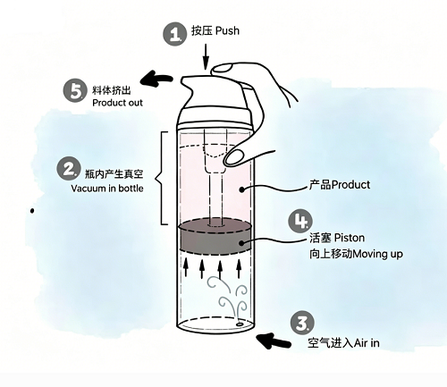
The design principle of a vacuum bottle is based on atmospheric pressure and relies heavily on the pumping force generated by its pump assembly. This pump assembly must possess superior unidirectional sealing capabilities to prevent air from flowing back into the bottle, thereby maintaining a low-pressure environment within the container. When the pressure differential between the low-pressure zone inside the bottle and the external atmospheric pressure exceeds the frictional force between the internal piston and the bottle wall, the atmospheric pressure drives the piston forward. Consequently, the piston must not fit too tightly against the bottle wall; otherwise, excessive friction would prevent it from advancing. Conversely, if the fit is too loose, leakage becomes a risk. Therefore, the manufacturing of vacuum bottles demands a very high level of technical expertise and precision.
Product Features
Vacuum bottles also offer precise dosage control. Once the pump assembly's diameter, stroke length, and spring tension have been calibrated, the dispensed volume remains consistently precise and quantitative with every pump-regardless of the specific design or shape of the accompanying actuator button. Furthermore, the discharge volume per pump can be adjusted by altering specific components within the pump assembly, achieving a precision of up to 0.05 milliliters, depending on the specific requirements of the product.
Once a vacuum bottle has been filled, from the moment it leaves the manufacturing facility until it is fully consumed by the end-user, virtually no air or moisture can enter the container. This effectively prevents contamination of the contents during use and extends the product's effective lifespan. Moreover, in alignment with current environmental trends and the growing demand to avoid the use of preservatives and antibacterial agents, vacuum packaging plays an increasingly vital role in extending product shelf life and safeguarding consumer interests.
Product Structure
Product Classification
By Structure: Standard Airless Bottles, Single-Bottle Composite Airless Bottles, Dual-Bottle Composite Airless Bottles, Non-Piston Airless Bottles.
By Shape: Cylindrical, Square (with cylindrical being the most common).
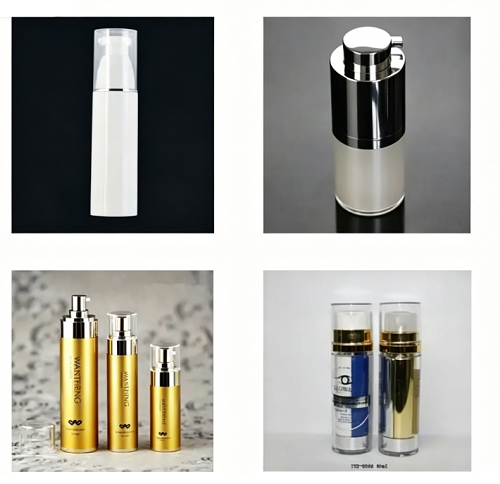
Vacuum bottles are usually cylindrical or oval, with common sizes ranging from 10ml to 100ml. They have a small overall capacity and rely on atmospheric pressure to prevent contamination of cosmetics during use. Airless bottles can undergo various surface treatments-such as electro-aluminum plating, plastic electroplating, spray coating, or the use of colored plastics-to enhance their appearance. While they are more expensive than standard containers, the minimum order quantity requirements are relatively low.
Product Structure Reference
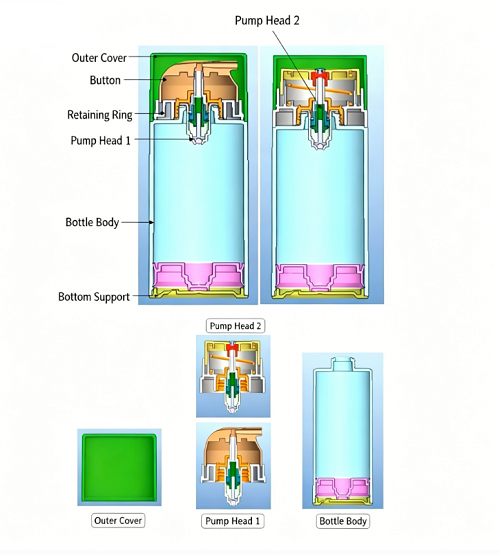
Reference for Structural Support Drawings

The main components of a vacuum bottle include: pump unit, cap, button, outer casing, threads, gasket, bottle body, large piston, base, etc. All exterior parts can undergo decorative treatments-such as electroplating, anodized aluminum sleeving, spray painting, silk screening, and hot stamping-depending on specific design requirements. Conversely, the pump assembly involves highly precision-engineered molds; consequently, clients rarely opt to commission their own custom tooling for this component. The key parts of the pump assembly consist of the small piston, connecting rod, spring, main housing, valve, and similar elements.
Other Types of Vacuum Bottles
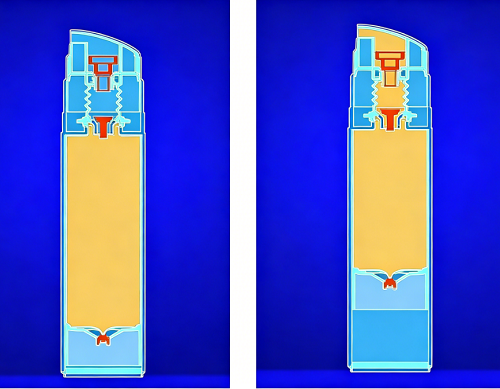
The all-plastic self-sealing valve vacuum bottle is a vacuum bottle containing skincare products, with a support disc at the bottom that can move up and down inside the bottle. The vacuum bottle has a round hole at the bottom. The bottom of the disc contains air, and the top contains skincare products. As the product is dispensed from the top via a pump mechanism, the support disc continuously ascends; once the skincare product has been fully consumed, the disc reaches the very top of the bottle's interior.
Cosmetic Bottle Applications
High-Activity Serums / Pre-Serums
These products typically contain ingredients prone to oxidation or deactivation-such as Vitamin C, retinol, Pro-Xylane, and peptides-which can easily discolor or lose potency upon exposure to air. Airless bottles utilize a negative-pressure environment within the container to ensure zero contact between the product formula and the air, thereby maximizing ingredient potency and extending shelf life. Additionally, when paired with a round-head pump, they allow for precise dosage control (0.1–0.5 ml per pump), effectively preventing product waste.
Cream-Based Products
Cream-based products-such as face creams and eye creams-are rich in nutrients and possess a high water content. Traditional open-jar packaging, which involves repeated contact with fingers and air, creates an environment highly susceptible to bacterial growth and oxidative spoilage. The pump-dispensing design of airless bottles enables "zero-contact dispensing," allowing users to access the product directly without the need for a spatula. This not only eliminates contamination from hands but also-thanks to a wide-mouth, flat-head pump-accommodates the high viscosity of creams, ensuring smooth dispensing with no residue. Furthermore, an internal piston mechanism ensures the product is almost completely evacuated from the bottle, minimizing waste at the bottom.
Liquid / Lotion-Based Products
For highly fluid products like toners and lotions, traditional packaging with screw-on caps often leads to evaporation, contamination, or oxidation caused by repeated opening and closing. When paired with a fine-mist spray pump or a standard dispensing pump, airless bottles can achieve uniform atomization for liquid formulas while ensuring consistent, stable dispensing for lotions. The sealed structure prevents liquid evaporation and spoilage, making this packaging format particularly suitable for formulas containing alcohol or ingredients prone to oxidation.