

Classification of Plastic Materials:
PET:An eco-friendly material suitable for direct contact with cosmetics and food products. It is a primary material for packaging organic skincare products. PET is relatively soft, and its natural state is transparent.
PP / PE: Eco-friendly materials suitable for direct contact with cosmetics and food products. They are primary materials for packaging organic skincare products. The natural color of these materials is whitish and semi-transparent. Depending on their specific molecular structure, they can be manufactured to achieve three distinct levels of hardness.
AS: Possesses moderate hardness and is relatively brittle (producing a crisp sound when tapped). It is transparent, with a slight bluish tint. It is suitable for direct contact with cosmetics and food products. In standard lotion bottles and airless pump bottles, AS is typically used for the bottle body; it can also be used to manufacture small-capacity cream jars. It presents a transparent appearance.
PCTA / PETG:Eco-friendly materials suitable for direct contact with cosmetics and food products. They are primary materials for packaging organic skincare products. These materials are relatively soft and transparent; being soft, PCTA and PETG are prone to scratching. Consequently, spray-painting is rarely applied to these materials; instead, printing methods are predominantly used.
Acrylic: A relatively hard material with high transparency, featuring a whitish base tone. To preserve its transparent aesthetic, acrylic packaging often undergoes an "inner-spraying" process (spraying the interior surface of the outer bottle).
ABS: An engineering plastic that is not considered eco-friendly. It possesses high hardness and is *not* suitable for direct contact with cosmetics or food products. In cosmetic packaging, ABS is typically used for components such as outer caps and shoulder collars. Its natural color tends to be yellowish or milky white.
Types of Packaging Bottles
Vacuum Bottles
Cap, Shoulder Cover, Vacuum Pump, Piston. They operate by utilizing air pressure.
The pump head typically features either a pointed "chicken-beak" tip or a flattened "duck-bill" tip. Airless bottles offer superior sealing performance; as the internal product volume decreases, the airless pump mechanism rises upward.
Any leakage that occurs would compromise the aesthetic appearance of the packaging.

Lotion Bottles
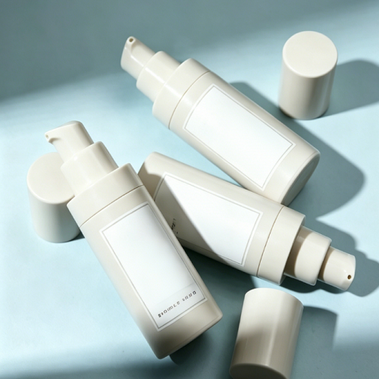
These consist of a cap, a shoulder collar, and a lotion pump. Most designs feature an internal dip tube.
Available in both single-layer and multi-layer configurations, these bottles typically feature an outer shell made of acrylic and an inner layer made of PP material. The caps are constructed with an outer layer of acrylic and an inner layer of ABS.
Perfume Bottles
Typically consist of a cap, a spray head, the bottle body, and a dip tube.
Large-capacity bottles are commonly made of glass, as this material is suitable for long-term storage. Some designs also feature a glass interior encased in an aluminum exterior. PP (polypropylene) bottles are suitable for small capacities and short-term storage.

Cream Jars
Consist of an outer cap, an outer jar, an inner liner, and a gasket.
Acrylic Double-Layer Cream Jars: Feature an acrylic bottle body, while the cap and gasket are made of PP. Acrylic offers high transparency but comes at a higher cost.
PP Double-Layer Cream Jars: Both the bottle body and the cap are made of PP material. They possess lower transparency, making them well-suited for designs involving colored packaging.
Single-Layer Bottles: The bottle body is typically made of PET, though other materials such as PP, PE, and PS may also be used. These can be combined with various complementary materials-such as electro-plated aluminum for the outer bottle or cap-to create diverse packaging applications.

Blow-molded Bottles
Typically made from PET material. These bottles are produced by directly blowing a preform into the final shape.
Their distinguishing features include a raised bump on the base and a relatively bright, glossy appearance under lighting.

Plastic-Aluminum Laminate Tubes
These feature an innermost layer made of PE material, encased in an outer aluminum packaging. Common finishing processes include offset printing, screen printing, and hot stamping.

All-Plastic Tubes
Typically manufactured using PE, PP, or PVC materials; the tubing is first extruded and then cut to size. Common finishing processes include offset printing, screen printing, and hot stamping.

Spray Heads, Lotion Pumps, and Hand Wash Pumps
Spray Heads
Available in snap-on styles (both semi-aluminum and full-aluminum) and screw-on styles (typically plastic). The plastic versions can be fitted with an outer aluminum sleeve or finished using processes such as electroplating.
Lotion Pumps
Commonly available in two nozzle types: pointed-tip and duckbill. Based on the dispensing mechanism, they can be categorized into vacuum-type and dip-tube-type models; all feature a screw-on thread.
Hand Wash Pumps
Characterized by a larger neck diameter and exclusively feature a screw-on thread. They come in a wide variety of shapes and can be paired with different pump heads to suit specific bottle designs.
Packaging Material Printing Processes
Screen Printing:The printed result features a distinct tactile relief (raised texture), as it involves the application of a layer of ink. For regularly shaped bottles (specifically cylindrical ones), the entire screen printing process can often be completed in a single pass. However, for irregularly shaped containers, each distinct printing area incurs a separate setup cost; similarly, each individual color used also incurs a separate setup cost. Furthermore, screen printing inks are categorized into two types: air-drying inks and UV-curable inks. Air-drying inks are prone to wearing off over time and can typically be removed by wiping with alcohol. UV-curable inks, conversely, possess a pronounced tactile relief and are extremely difficult to remove.
Hot Stamping: This process involves transferring a thin foil layer onto the surface using heat and pressure; consequently, it lacks the tactile relief characteristic of screen printing. Ideally, hot stamping should not be applied directly to packaging made from PE (polyethylene) or PP (polypropylene) materials; instead, a thermal transfer process should be performed first, followed by the hot stamping. Alternatively, if high-quality hot stamping foil is utilized, direct stamping may be feasible. Note that hot stamping cannot be applied to aluminum-plastic laminate tubes, though it is suitable for all-plastic tubes.
Water Transfer Printing: This is a printing process performed by immersing the object in water, resulting in a non-uniform, irregular pattern. The resulting textures and patterns are inherently inconsistent from piece to piece, and the process is generally more expensive than other methods.
Thermal Transfer Printing:This method is predominantly used for high-volume production runs and for products featuring complex graphic designs. It involves applying a thin film layer onto the surface of the packaging material. This process tends to be relatively expensive.
Offset Printing:This technique is primarily utilized for aluminum-plastic laminate tubes and all-plastic tubes. When printing white graphics or text on a colored tube substrate, screen printing *must* be used; if offset printing is attempted in such cases, the underlying base color of the tube will show through the white ink. Additionally, a glossy or matte protective film is sometimes applied to the surface of the tube following the printing process.
Coloring Processes
Anodized Aluminum: Features an aluminum exterior consisting of a thin layer wrapped over an inner plastic core.
Electroplating (UV): Compared to spray painting, this process produces a glossy, bright finish.
Spray Painting: Compared to electroplating, this process produces a matte, subdued finish.
Brushed Metal/Foil Wrapping : Essentially involves applying a thin film; upon close inspection, a seam or joint line can be detected on the surface of the bottle.
Secondary Anodization: A process involving a second round of anodization applied over an existing anodized layer. This technique creates a visual contrast where matte patterns appear over a glossy background, or vice versa. It is frequently used for creating logos.
Injection Molding Coloration: Achieved by adding color pigments to the raw material during the product's injection molding phase. This is a relatively inexpensive process. Pearlescent pigments may also be added to create a shimmering effect; alternatively, titanium dioxide powder can be added to transform transparent PET into an opaque material. The appearance of "water ripple" patterns is directly related to the quantity of pearlescent pigment added.