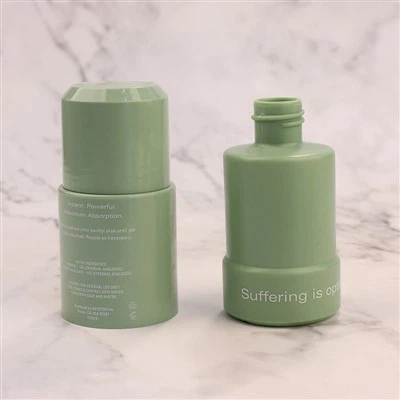
Roller Ball Structure
Ball Seat & Rotation Mechanism
Roll-on deodorant bottles use a press-fit ball seat to hold the roller ball inside the bottle neck. During application, the ball rotates against the seat surface and transfers liquid deodorant through rolling contact. Common roller ball materials include stainless steel, PP, and PE, with diameters typically ranging from 25 mm to 35 mm.
Liquid Transfer Process
The liquid formulation contacts the lower surface of the roller ball inside the container. As the ball rotates across the skin surface, liquid transfers through capillary contact and controlled surface wetting. Ball clearance and seat tolerance affect dispensing rate and rolling resistance during repeated application cycles.
Assembly & Integration
During production, the roller ball is inserted into the housing by pressure fitting after liquid filling. The housing geometry must maintain sufficient retention force to prevent ball detachment during transport while allowing continuous rotation under manual application pressure.

Roll On Deodorant Bottles Leak Prevention Performance
Leak Prevention Performance
It features a bottle neck typically fitted with a PE sealing insert beneath the threaded cap. When the cap is tightened, axial compression applies force to the roller housing and reduces liquid escape paths around the ball seat during storage and transport.
Leakage Control During Transport
It adopts a sealing structure that reduces leakage caused by vibration, bottle inversion, or pressure fluctuation during logistics handling. Their HDPE and PET bottle bodies maintain dimensional stability under ambient storage conditions between approximately 5°C and 45°C.
Failure Risk Control
Leakage may occur if cap torque is insufficient, roller seat tolerance exceeds specification, or formulations contain aggressive solvents that deform plastic sealing components. Material selection and dimensional control directly affect long-term sealing performance.
Roll On Deodorant Bottles Formula Compatibility
Alcohol-Based Formulations
HDPE and PET bottle bodies are commonly used for alcohol-based deodorant liquids containing fragrance oils and antiperspirant agents. Material compatibility testing typically evaluates stress cracking, swelling, and surface deformation after long-term liquid contact.
Viscosity & Dispensing Behavior
Low-viscosity formulations transfer more easily through roller ball rotation, while high-viscosity liquids may reduce rolling speed or increase dispensing resistance. Roller diameter and ball surface finish influence liquid output consistency during application.
Chemical Resistance of Components
Different bottle components contact different formulation ingredients during storage. Stainless steel balls resist corrosion from water-based deodorants, while PP caps and PE inserts help isolate volatile compounds and reduce solvent evaporation inside the container.
Hot Tags: roll on deodorant bottles, China roll on deodorant bottles manufacturers, suppliers, factory, deodorant containers eco friendly, eco friendly deodorant containers wholesale, eco friendly deodorant tubes wholesale, deodorant tubes eco friendly